
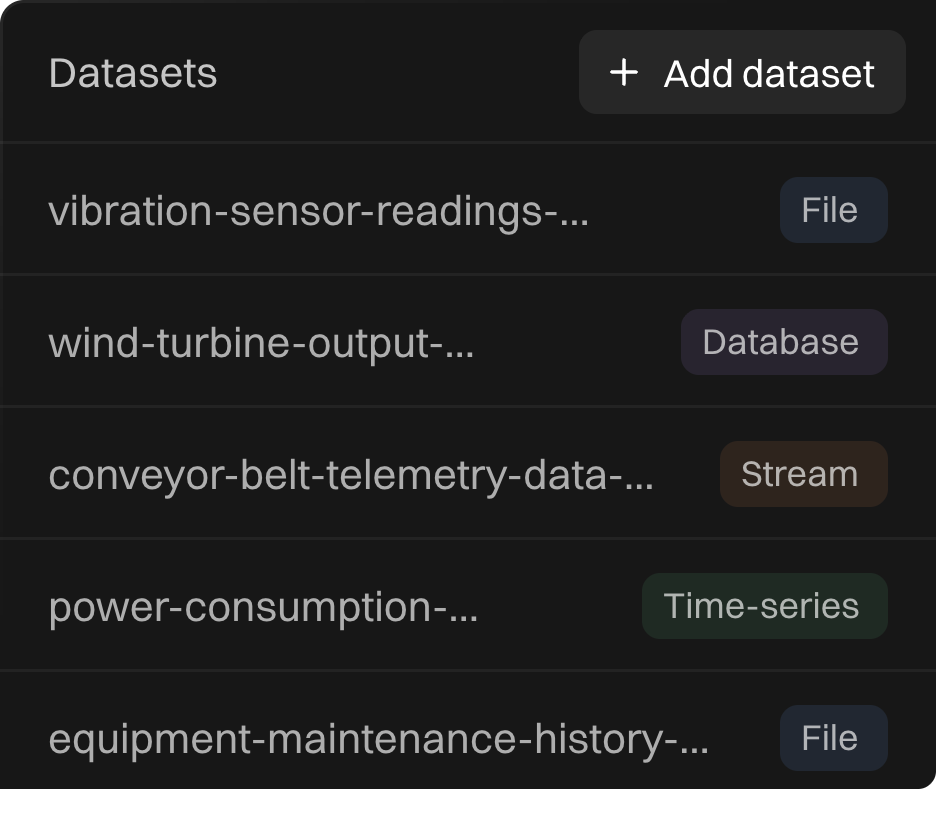
Five source types
Register datasets from files, SQL databases, Kafka and NATS streams, or Prometheus metrics, through one registration flow.
Training workflows
Compose pipelines visually from reusable components, or write them in Python. They run on Kubeflow Pipelines in your cluster.
Distributed training jobs
Pick a PyTorch or TensorFlow algorithm, a registered dataset, workers and GPUs, and submit. The trained model is registered when the job finishes.
LLM fine-tuning
Adapt an open-weight LLM to your domain with LoRA or NTK on a registered JSONL dataset. Each adapter keeps the link to its base model.
One record per model
Owner, training parameters, artifacts, linked datasets and validation metrics are stored on the model itself.
Version comparison
Compare versions side by side, with the hyperparameters of each version next to its metrics and the metric changes calculated for you.
Model recommender
Rank registered models by their recorded validation metrics and pick the best candidate for a task.
Change history
See who created each model, who changed it last, and when.
Right-sized LLM serving
Enter a model and the number of concurrent users. The platform reads free cluster capacity and recommends quantization, KV cache type and context length.
Controlled model updates
Send a share of traffic to a new classical model version, watch it, then commit or roll back without redeploying.
Adapters with their base
Serve a fine-tuned LoRA adapter from the same deployment as its base model.
Test from the console
Send a request to a served model from the browser. The endpoint stays inside the cluster, and each user reaches only their own services.
Built on open tools
Runs on Kubernetes with Kubeflow Pipelines, the Kubeflow Training Operator, MLflow, MinIO and KServe.
Owner-based access
Work runs in each user’s own namespace. Every dataset and model has an owner, who decides which other users can read it.
Console, API and SDK
Work in the web console, call the REST API, or use the Python SDK from notebooks and scripts.
Agent access over MCP
AI assistants can query models, datasets, deployments and pipeline runs as Model Context Protocol tools. Each call sees only that user’s resources.